About Nitrocellulose Grade C
We are a specialized company in innovation, production, and distribution of agricultural chemicals, industrial chemicals, food chemicals, inorganic chemicals, mining chemicals and organic chemicals
1. 100+ food/feed ingredients. 2. 138 food ingredients formulas. 3. 5 invested factories to ensure excellent quality and stable supply. 4. 2 labs with 30 technicians to provide formulas and technical support. 5. 5 warehouses covering an area of 5,000 square meters to ensure competitive prices.
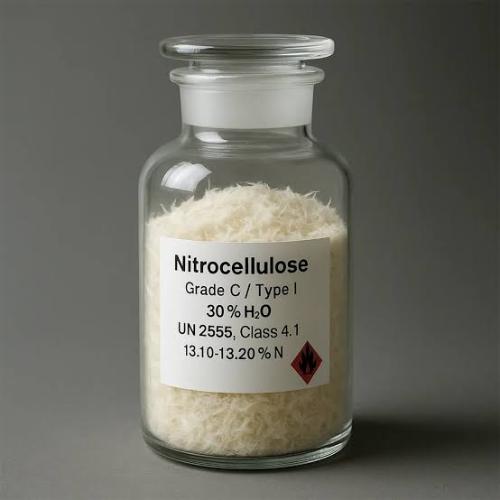
Safe Handling and StorageNitrocellulose Grade C must be stored under standard safety protocols. The material is stabilized with 30% water content, which prevents accidental ignition and decomposition. Always keep it in original, moisture-sealed containers, away from heat, sparks, open flame, and direct sunlight. Handling should be done in well-ventilated, explosion-proof environments using non-sparking tools and equipment.
Industrial Uses and ApplicationsThis grade of nitrocellulose is utilized in industries as a high-performance binder in paints and inks, a film former, and a propellant. Its solubility in acetone and ethyl acetate makes it ideal for coatings and adhesives. Nitrocellulose finds further utility where rapid-drying and flexible films are required, providing both adherence and durability in the end product.
Physical and Chemical StabilityThe moisture content of 30% is crucial for stabilizing nitrocellulose. If allowed to dry, the substance becomes dangerously unstable and highly flammable. Its decomposition begins at temperatures above 140C, so temperature control and humidity are essential for safe operation and storage throughout its shelf life.
FAQ's of Nitrocellulose Grade C:
Q: How should Nitrocellulose Grade C be safely stored and handled?
A: Nitrocellulose Grade C must be stored in cool, well-ventilated conditions, in moisture-retaining, sealed containers. Avoid heat, sparks, and open flames, and handle it only with non-sparking tools and protective equipment to minimize ignition risks.
Q: What is the process for using Nitrocellulose Grade C in industrial applications?
A: To use Nitrocellulose Grade C, dissolve it in compatible organic solvents like acetone or ethyl acetate, depending on the formulation. It acts as a binder or film former in paints, inks, and coatings, providing rapid drying and strong film properties.
Q: When does Nitrocellulose Grade C become unstable or hazardous?
A: Nitrocellulose loses stability if it dries out (moisture content drops), is exposed to heat above 140C, or comes into contact with ignition sources. It should always remain wet with 30% water for safe handling and storage.
Q: Where is Nitrocellulose Grade C typically used?
A: It is primarily used in industrial settings as a binder for paints and inks, a propellant in pyrotechnics, and as a film former for adhesives and coatings. It is not suitable for domestic use due to its hazards.
Q: What are the benefits of using Nitrocellulose Grade C in manufacturing?
A: Nitrocellulose Grade C offers quick drying, good adhesion, and flexible film formation. Its solubility in various organic solvents allows for versatile industrial formulations in coatings, inks, and specialty adhesives.
Q: Is Nitrocellulose Grade C toxic or poisonous?
A: Yes, it is considered hazardous and can be poisonous if inhaled, ingested, or improperly handled. Proper personal protective equipment is mandatory during handling to prevent health risks.
Q: How does the moisture content contribute to Nitrocellulose Grade C's safety?
A: The 30% water content helps stabilize Nitrocellulose, suppressing its flammability and reducing the risk of accidental decomposition. If the moisture level decreases, the material becomes far more dangerous to store and handle.




 Send Inquiry


 Send Inquiry
 Send Inquiry
